Your closet is full, but getting dressed still feels hard. Maybe you love bold prints, layered jewelry and bright colors, and you are curious about a calmer, simpler way to dress. Or maybe you already feel tired of too many choices.
Here is the short version. Maximalist outfits mix many colors, patterns and statement pieces. Minimalist outfits use fewer colors, simpler shapes and pieces that work together. You can move from one toward the other slowly, without throwing out everything you own. This guide explains the differences and gives you a step-by-step way to adapt minimalism to your own style.
Minimalist vs. maximalist fashion: the short answer
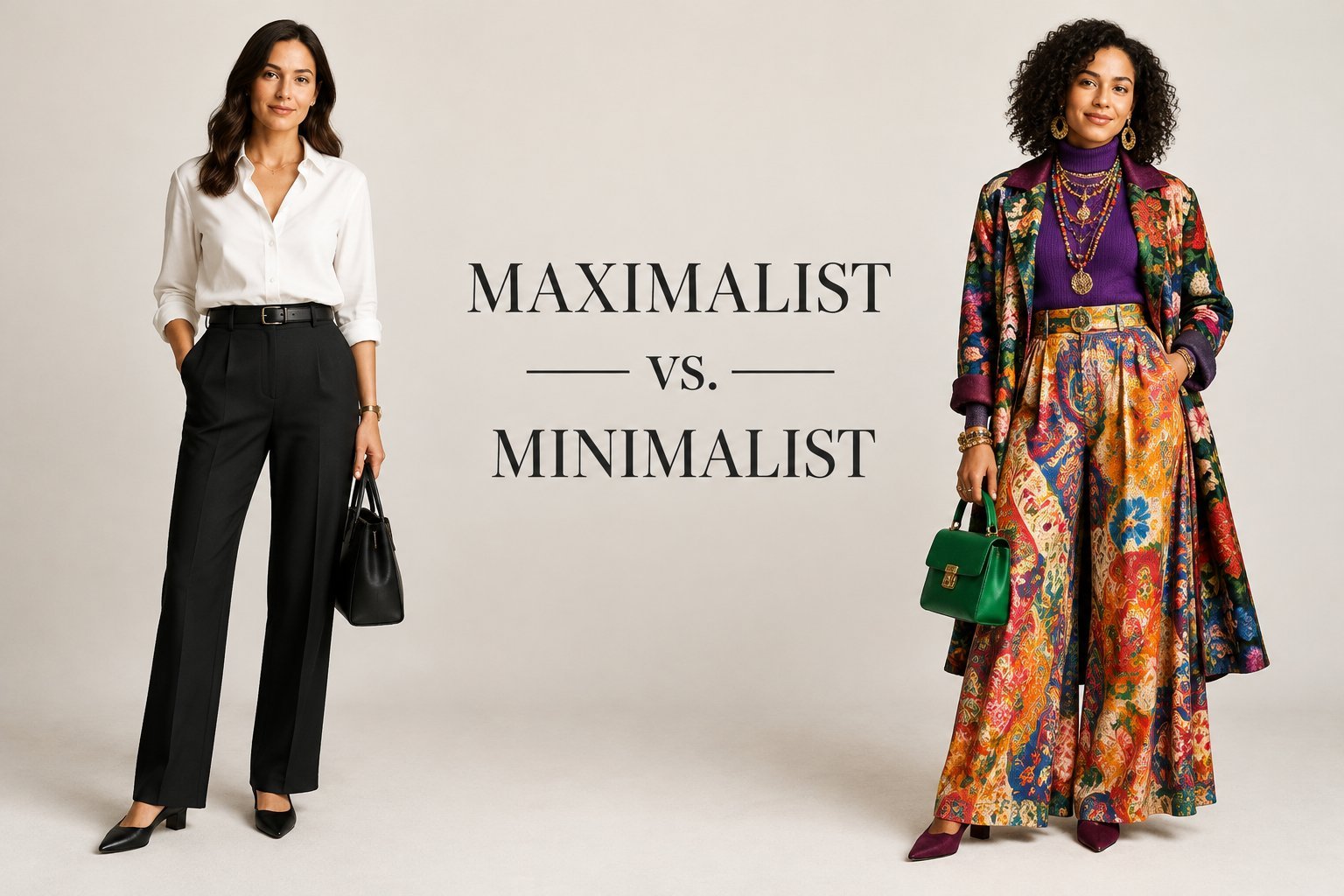
Minimalist fashion focuses on simple silhouettes, a limited color palette and pieces that combine easily. The goal is a closet where most items work with most other items.
Maximalist fashion focuses on expression. It layers colors, prints, textures and accessories, often in unexpected combinations. The goal is a look that feels personal and bold.
Here is how they compare at a glance:
| Minimalist | Maximalist | |
|---|---|---|
| Color | Few colors, often neutrals with one or two accents | Many colors, often bright or contrasting |
| Pattern | Solid colors, or one simple pattern like stripes | Multiple prints worn together |
| Accessories | Few and understated | Many, layered and noticeable |
| Closet logic | Pieces are chosen to combine with each other | Pieces are chosen to stand out |
| Main strength | Easy mornings, consistent looks | Strong personal expression |
| Main risk | Can feel plain or repetitive | Can lead to a crowded closet with few usable outfits |
Neither style is better. They answer different needs. The practical problem is not “maximalist” or “minimalist.” It is whether your clothes work together and whether you actually wear them.
The difference between minimalist and maximalist outfits
The two styles differ in four main ways.
Color
A minimalist outfit usually sticks to a small palette, such as black, white, gray, navy, camel or olive, with maybe one accent color. A maximalist outfit might combine a red skirt, a green top and a yellow bag on purpose.
Color alone does not define the style. A minimalist can wear a single bright cobalt dress and still be minimalist, because the outfit is simple and nothing competes with it.
Pattern and texture
Minimalist outfits tend to use solid colors or one quiet pattern, like thin stripes. Texture adds interest without adding noise: a ribbed knit, a crisp cotton shirt or a smooth leather belt.
Maximalist outfits often mix patterns, such as floral with plaid or polka dots with animal print. The skill is in choosing prints that share a color or scale.
Layers and accessories
A minimalist might wear a watch, small earrings and one bag. A maximalist might add stacked rings, a scarf, a hat and a bold necklace. Both can look intentional. The difference is how many elements are asked to carry the outfit.
With fewer details competing for attention, proportion becomes more noticeable. Try a relaxed shirt with straight trousers, or a fitted top with a fuller skirt, and check whether the balance feels comfortable to you. These are starting points, not body-shape rules. If you prefer loose clothing throughout, a repeated color or a defined hem length can help the pieces feel connected.
Try outfits while sitting, walking and reaching, rather than judging them only in a mirror. Check whether waistbands dig in, sleeves restrict movement or fabric needs constant adjusting. A small alteration, such as shortening trousers or adjusting a sleeve, may make an existing piece easier to wear than buying a replacement.
How each style shops and builds a closet
This is where the difference matters most for everyday life. A minimalist closet is built around combinations: “Will this work with at least three things I already own?” A maximalist closet is often built around single pieces: “I love this, and it makes me happy.”
The maximalist method is not wrong. It just makes it easy to own many beautiful items that do not go together. Many people who want to adapt minimalism are really solving this problem.
You don’t have to pick a side
Most people do not live at either extreme. Think of style as a dial, not a switch.
You might choose a minimalist base of plain tops, trousers and shoes, then add one maximalist element, like a printed scarf or bold earrings. Or you might keep a colorful wardrobe but organize it into a tight palette, so everything still works together.
Adapting minimalism does not mean losing personality. It means deciding where your personality shows up, and letting everything else support it.
Why getting more from your clothes matters
There are practical reasons beyond looks to wear what you own for longer.
WRAP, a UK-based charity, describes extending the life of clothing as the single largest opportunity to reduce the carbon, water and waste footprints of clothing in the UK. The idea is simple: if clothes stay in use longer, fewer need to be made and thrown away. Keep in mind that this research focuses on the UK and on industry-wide effects, so it does not tell you exactly what your own closet changes will do.
In the United States, the EPA estimated that 17 million tons of textiles were generated as municipal solid waste in 2018, and that discarded clothing is the main source. That is the most recent year in that report. It shows the scale of the issue, though it does not mean any one person’s choices will fix it.
These sources support one general point: using clothes longer is better than replacing them quickly. The styling advice in the rest of this guide, such as palettes, outfit formulas and statement pieces, is practical suggestion, not research findings.
How to transition from maximalist to minimalist fashion
Move in stages. A sudden clear-out usually leads to regret and re-buying. These six steps work for most people.

Step 1: Define what minimalism means for you
Before you touch a single hanger, write one or two sentences about what you want. Examples:
- “I want to get dressed in under ten minutes.”
- “I want outfits that match without much thought.”
- “I want to stop buying clothes that are kept only in wardrobe for long time.”
Your answer sets the direction. Someone who wants speed will edit differently from someone who wants a smaller budget.
Step 2: Track what you actually wear
For two to three weeks, note what you put on each day. A quick phone note works. You can also turn all your hangers backward and flip each one the right way after you wear the item.
Pay attention to patterns. Which pieces do you reach for again and again? Which ones hang untouched? What do the favorites have in common: fit, fabric, color, comfort?
Also record why you skip something. A shirt may match your palette but need ironing you rarely have time for. Shoes may look versatile but feel uncomfortable on your commute. These practical barriers matter more than how useful an item appears on paper. Separate occasional clothing from everyday clothing when reviewing the results: a wedding outfit does not need weekly wear to earn its place.
This step uses your real habits, not an ideal version of yourself.
Step 3: Choose a simple color palette
Look at your most-worn items and pick a palette from them. A simple structure is:
- 2–3 base colors for most of your clothes, such as navy, white and camel
- 1–2 accent colors for items you love, such as burgundy or forest green
If your favorites are mostly bright, your palette can be bright. The aim is fewer colors that work together, not beige by default.
Step 4: Edit in rounds
Do not decide everything in one afternoon. Try three rounds:
- Easy goes: items that do not fit, are damaged beyond repair, or that you dislike.
- Maybe box: items you like but rarely wear. Store them out of sight for a few months. If you don’t find yourself reaching for them, consider letting them go.
- Keepers: items you wear often and that fit your palette.
For more on why clearing space helps, see our article on the benefits of decluttering for a minimalist wardrobe. If you decide to resell items in good condition, our guide to the best apps to sell clothes for a minimalist wardrobe can help.
Step 5: Keep one or two statement pieces
You can simplify your wardrobe while keeping your personal style. Choose a small number of bold items, such as a printed silk scarf, a vivid coat or a pair of sculptural earrings, and treat them as the focus of an outfit.
A helpful rule: one star per outfit. If you wear a loud print, keep the rest quiet. This is a styling suggestion, not a rule everyone must follow, but it works well for people who are new to simpler dressing.
Step 6: Shop last
After editing, you will see the gaps. You might have plenty of tops but struggle to find trousers that pair well with them. Write the gaps down and wait before buying anything. Ask whether an item you already own could fill the role.
Before purchasing, name three complete outfits you could make with the item, including shoes and any necessary layers. Then check the care label, fabric opacity, closures and return policy. If it only works after buying several other things, it may not solve the gap you identified.
Price alone does not show value. A cheaper top that needs frequent replacement may cost more over time than a well-used alternative, but expensive clothing is not automatically durable. Inspect seams, fabric condition and fit, whether shopping new or secondhand. Set a spending limit first and prioritize the missing piece that would unlock the most outfits.
When you do buy, our guide to minimalist shopping and our tips for building a minimalist wardrobe on a budget can keep purchases intentional.
A mix-and-match example: 10 pieces, 9 outfits
This example shows how a small set of clothes creates distinct outfits. It is built for mild to cool weather, roughly spring or fall in much of the U.S. and Canada.
The pieces (10 garments and shoes):
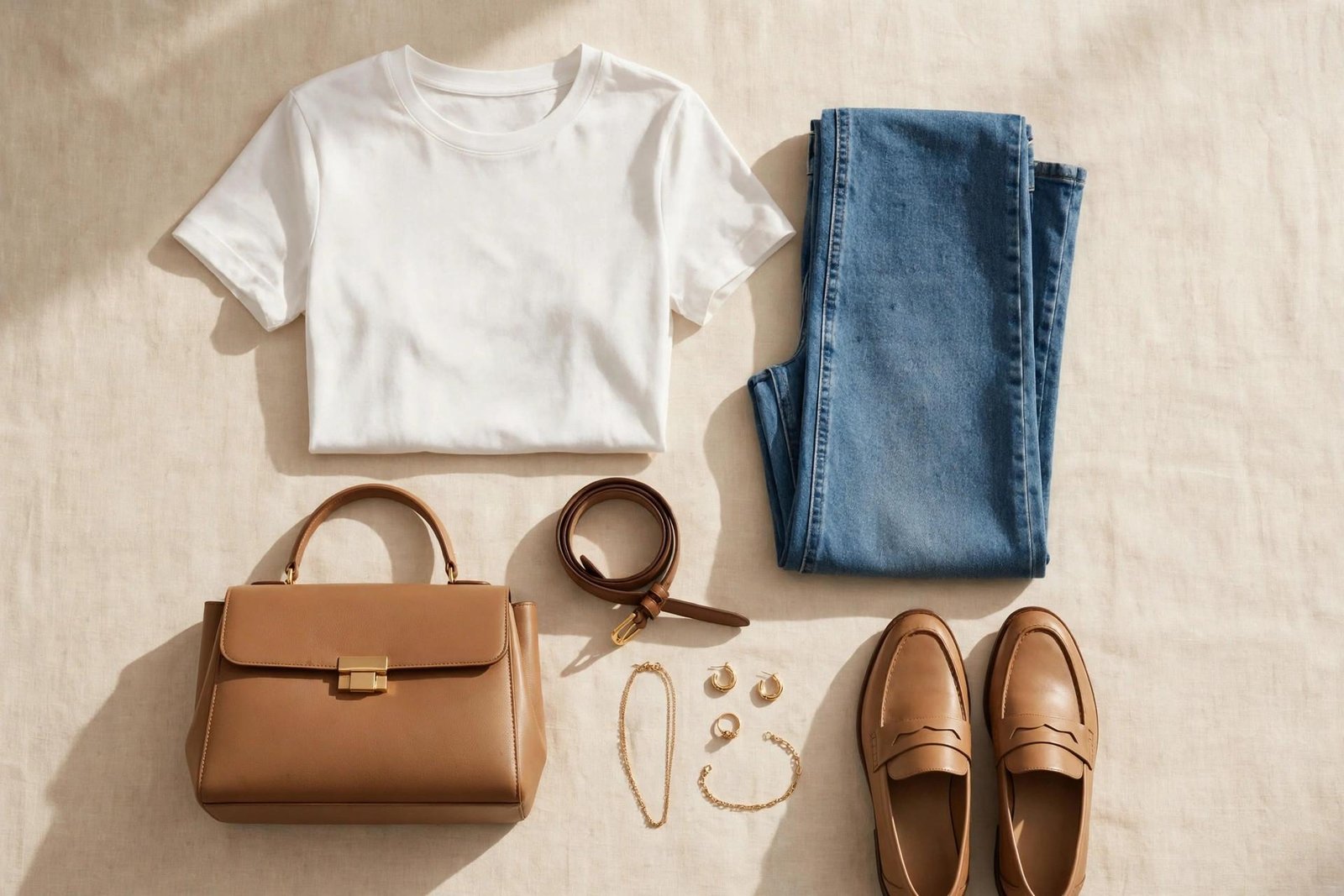
- Tops (3): white cotton tee, gray mid-weight sweater, navy-and-white striped long-sleeve top
- Bottoms (3): dark straight-leg jeans, black tailored trousers, camel midi skirt
- Layers (2): black blazer, stone-colored trench coat
- Shoes (2): white leather sneakers, black ankle boots
Three tops paired with three bottoms gives nine base outfits. Each one gets its own shoes or layer, chosen for weather and occasion:
| # | Outfit | Good for |
|---|---|---|
| 1 | White tee + jeans + white sneakers | Mild weekend, errands |
| 2 | White tee + trousers + blazer + black boots | Work meeting |
| 3 | White tee + camel skirt + blazer + white sneakers | Smart-casual, a warmer day |
| 4 | Gray sweater + jeans + black boots | Cool casual day |
| 5 | Gray sweater + trousers + trench + white sneakers | Cool commute with light rain |
| 6 | Gray sweater + camel skirt + black boots | Cool (not cold) workday or dinner |
| 7 | Striped top + jeans + trench + black boots | Breezy day out |
| 8 | Striped top + trousers + black boots | Office casual |
| 9 | Striped top + camel skirt + white sneakers | Mild weekend |
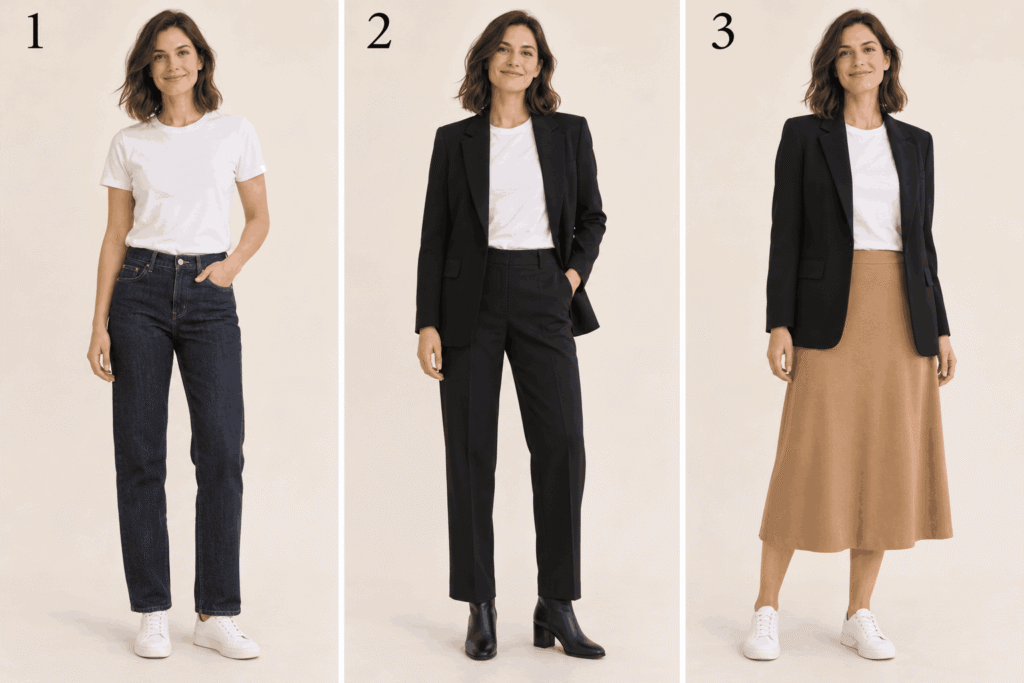
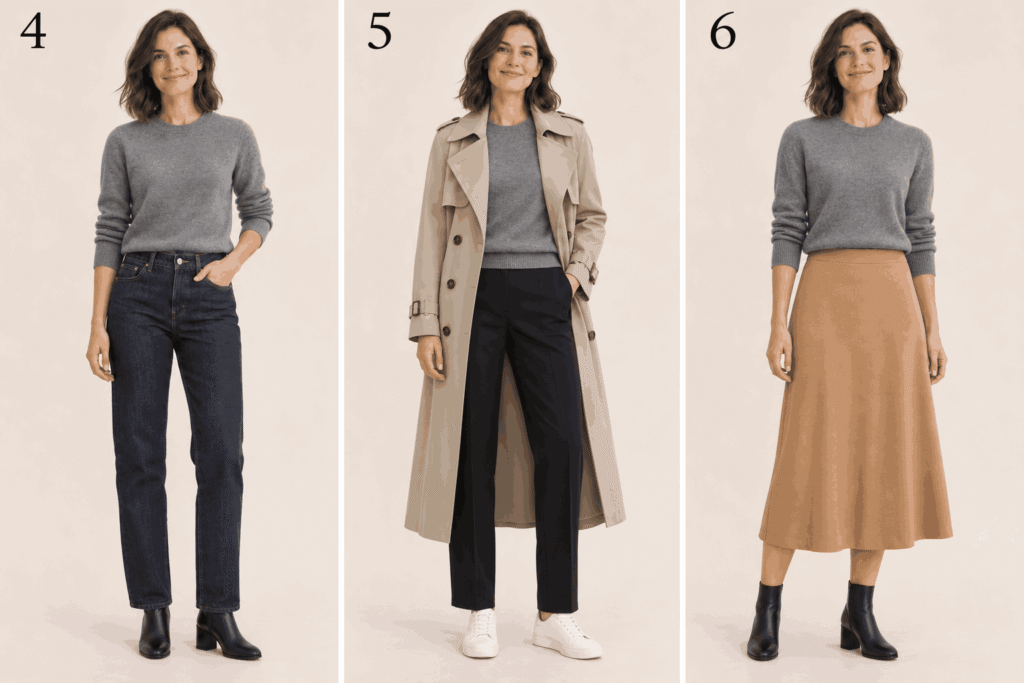
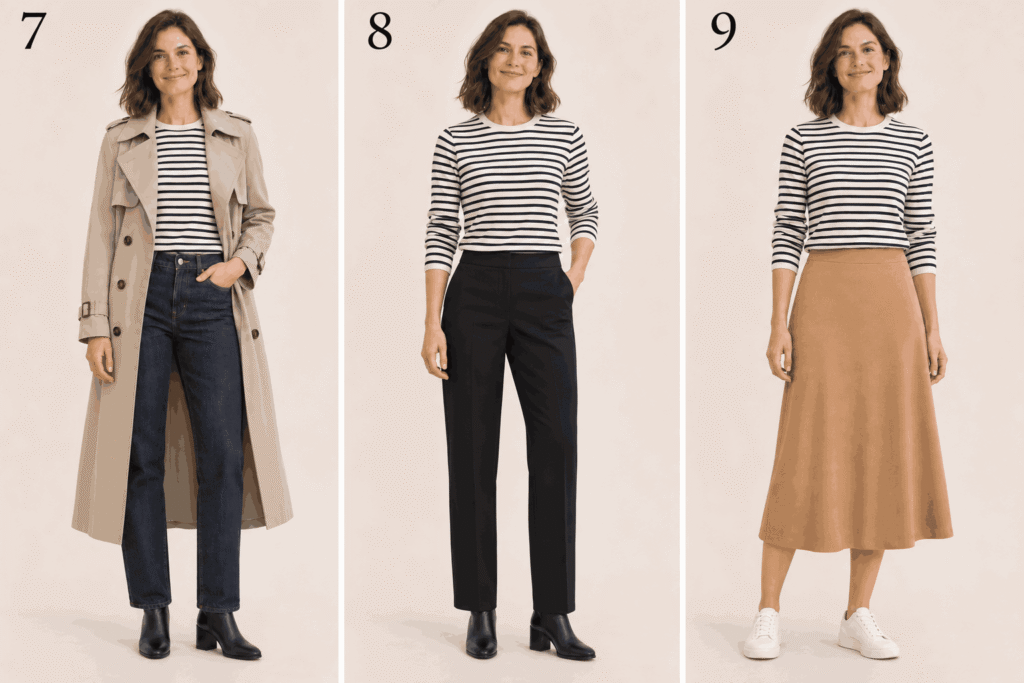
A few notes on this example:
- Each outfit uses a different pairing of top and bottom, so the nine are distinct. Changing shoes or layers would stretch the count further, but not every combination suits every day. A sweater under a trench in warm weather, for example, would be uncomfortable.
- If you keep one maximalist piece, such as a printed silk scarf, it works best with the solid tops (tee or sweater). Skip it with the striped top so two patterns do not compete.
- In very hot or very cold climates, you would swap some pieces: lighter fabrics for heat, a warmer coat and layers for cold.
- Sizes, fit and comfort matter more than the exact items. Use this as a template and replace each piece with what you already own.
Test the capsule against your laundry routine before reducing your wardrobe further. Three tops may demonstrate combinations, but they may not cover a full week between washes, especially in hot weather or during active work. Keep enough everyday clothing to avoid emergency laundry, and allow for drying time.
Photograph combinations you actually enjoy and save them in a phone album. When an outfit fails, note the specific problem: the sweater bunches under the blazer, the skirt catches on the boots, or the shoes feel too casual for work. Swap that element and test again. Useful combinations come from wearing the clothes, not simply multiplying the number of tops and bottoms.
For a seasonal view, see our seasonal minimalist outfit ideas.
Three scenarios and what they teach
These are hypothetical examples, not real people. Each shows a different lesson.
Scenario 1: Maya clears her closet in a weekend.
Maya loves bright prints. After reading about minimalism, she donates most of her wardrobe in one weekend and keeps only neutral basics. Two weeks later, she feels out of place in her own clothes and starts buying again.
The lesson: Fast purges often backfire. A maybe box and a gradual edit would have let Maya keep a few items she loved while she learned what she actually wore.
Scenario 2: Jordan goes all neutral.
Jordan wears vivid colors every day. Wanting to simplify, Jordan swaps everything for gray, black and beige. The closet is tidy, but getting dressed feels dull, and Jordan stops enjoying fashion.
The lesson: Minimalism is about fewer, well-matched items, not removing the colors you love. A palette of navy, white and one bold accent, such as emerald green, would have kept Jordan’s personality in the outfits.
Scenario 3: Dana buys a new “minimalist” wardrobe.
Dana decides to try minimalism and buys a set of new basics. She already owns three black sweaters and two pairs of dark jeans. The new pieces end up duplicating what she has, and her closet is fuller than before.
The lesson: Start with what you own. An audit would have shown Dana that she already had most of what she needed.
Common mistakes when adapting minimalism
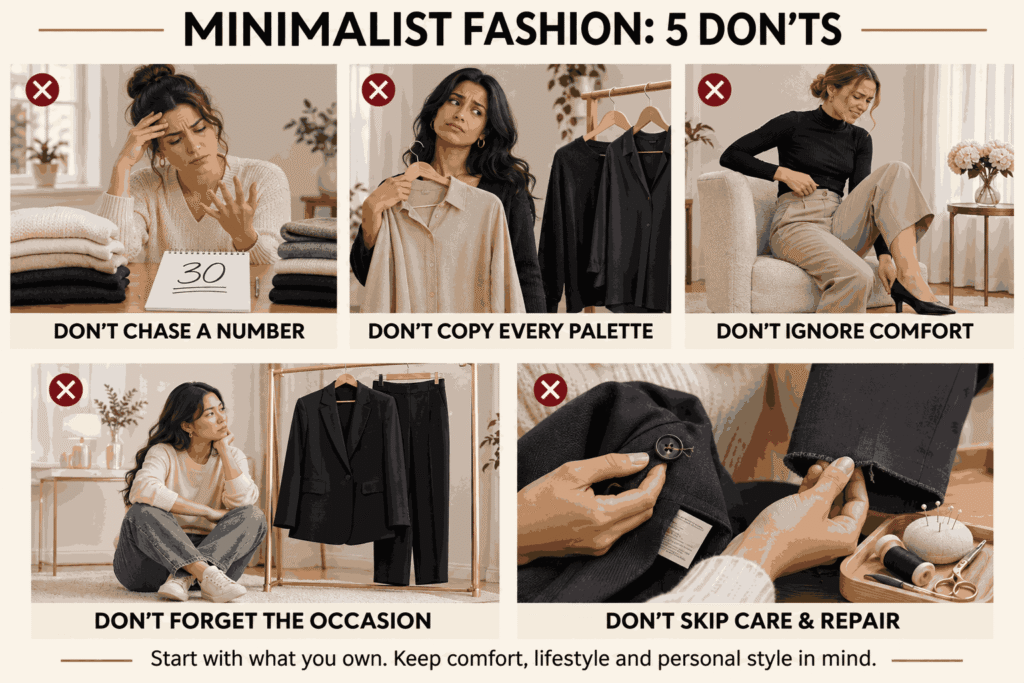
- Treating minimalism as a number. There is no correct item count. The right size depends on laundry habits, climate, job and lifestyle.
- Copying someone else’s palette. A palette that suits another person may not suit your skin tone, hair color or taste. Build yours from your own favorites.
- Ignoring comfort. An outfit that looks great but feels bad will stay in the closet. Keep fit, fabric and ease of movement in mind.
- Forgetting the occasion. A closet that works for weekends may not cover work events or formal days. Plan a few pieces for each situation you actually face.
- Skipping care and repair. Clothes you keep longer need to last longer. Follow care labels, fix loose buttons and hems, and have items tailored if the fit is almost right.
Make care easy to follow. Keep a small repair kit accessible and set aside items needing attention, so they do not disappear among wearable clothes. Before replacing a faded or misshapen piece, check whether cleaning, mending or altering it could reasonably restore its everyday usefulness.
Minimalist fashion for beginners: a first-week plan
Beginners often want a clear starting point. Here is a simple one.
- Day 1: Write down why you want to simplify.
- Days 2–7: Note what you wear each day.
- End of week: Look at your list and pick the five outfits you liked best. Write down the colors, shapes and fabrics they share.
- Next weekend: Remove only the easy goes, such as items that do not fit or are worn out.
That is enough for one week. Rushing the rest tends to lead to regret.
If your situation is more specific, these guides may help: minimalist fashion tips for students, minimalist wardrobe for working women, or the 70/30 rule for a minimalist wardrobe.
Limitations to keep in mind
Minimalism is a tool, not a requirement.
- Dress codes. Some jobs or events require specific clothes. Work within those rules.
- Climate. Cold winters or hot summers may require more items than a simple template suggests.
- Budget. Replacing items takes money. If funds are tight, working with what you own is a better path.
- Personal taste. Some people feel happiest with a full, colorful closet. If a maximalist wardrobe works for you and you wear everything in it, nothing needs to change.
Conclusion
Adapting minimalism is less about choosing between maximalist and minimalist outfits and more about making your clothes work together. Track what you wear, choose a palette, edit in rounds, keep a few favorites and shop last.
Your next step is small: this week, write down the five outfits you wear most often and note what they have in common. That list is the starting point for your own version of minimalism.
Which piece in your closet would you keep as your one statement item?