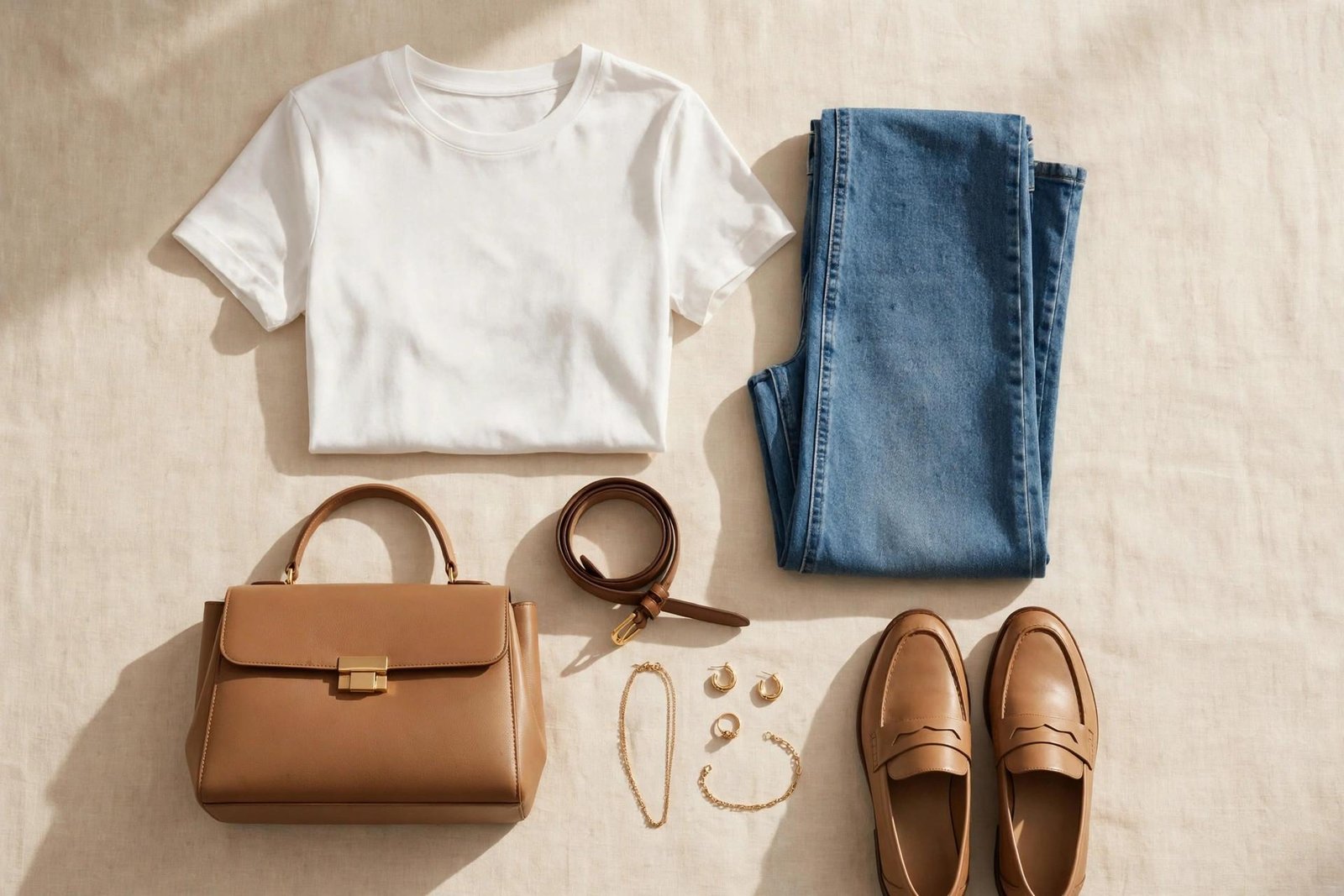

Most women can build a practical capsule closet with two to four pairs of jeans. Three is a sensible starting point: one everyday pair, one alternative wash or cut, and one option for slightly dressier outfits.
That number is a styling guideline, not a researched standard. Your ideal count depends on how often you wear denim, your laundry routine, your climate, your dress code, and how comfortably each pair fits.
A woman who wears jeans almost daily may regularly use four pairs. Someone who prefers trousers, skirts, or dresses might need only one—or none.
The aim is to keep enough jeans to support your routine without filling your closet with uncomfortable pairs, unnecessary duplicates, or styles you rarely choose.
This guide explains how to find your number, assess your current collection, create outfits with fewer pieces, and care for the jeans you keep.
The Short Answer: Start With Three, Then Adjust
Use your weekly routine as a starting point:
| How you wear jeans | A reasonable starting range |
|---|---|
| Once or twice a week, mostly casually | 1–2 pairs |
| Three to four days a week, across casual and smart-casual activities | 3 pairs |
| Almost every day, across work, errands, and weekends | 3–4 pairs |
| Rarely, because you prefer trousers, skirts, or dresses | 0–1 pair |
These ranges are suggestions, not shopping targets. If you own two comfortable pairs that cover your needs, you do not need a third simply to complete a formula.
Likewise, four regularly worn pairs can make sense in a small wardrobe if denim is your main everyday clothing.
Before buying or removing anything, observe your habits for a few weeks. Notice whether you run out of suitable jeans between laundry days or repeatedly ignore several pairs.
Your actual choices offer a better guide than an arbitrary limit.
What Makes Jeans Useful in a Capsule Closet?
A capsule closet is a collection of clothes that work together and suit your everyday life. It does not require a fixed number of garments, an entirely neutral palette, or identical outfits.
Jeans earn their place when they make getting dressed easier.
A useful pair should fit comfortably, coordinate with several tops, work with your usual shoes, and suit activities you regularly do.
For example, dark straight-leg jeans might work with a shirt for a relaxed office, a sweater for errands, and a blouse for dinner.
However, versatility is personal. If you rarely wear blue, black jeans may be your easiest option. If structured denim feels uncomfortable, softer trousers might serve you better.
Choose pieces according to your preferences and routine rather than treating a capsule checklist as compulsory.
Why Jeans Deserve Careful Counting
Jeans can accumulate quietly. You might own pairs bought on sale, styles from different trend cycles, and several sizes, while consistently wearing only two favorites.
Fit often explains the gap between ownership and use.
In its report on UK clothing, WRAP found that around 30% of clothing in the average wardrobe had not been worn for at least a year, most commonly because it no longer fit.
That finding concerns clothing generally, not jeans specifically, and reflects a particular study context. Still, it highlights a useful question: how much of your wardrobe is available to wear comfortably today?
There is also an environmental reason to avoid unnecessary purchases. Levi Strauss & Co.’s 2015 assessment of its 501 jeans reported nearly 3,800 liters of water over a pair’s lifetime, with consumer care having the second-highest impact on water use after cotton growing.
Those results should not be applied to every pair of jeans. Materials, production methods, and care habits vary.
The practical takeaway is to choose jeans thoughtfully, use them regularly, and maintain them well.
Five Factors That Determine Your Ideal Number
1. How often you wear denim
Think about the past two weeks. How many days did you actually wear jeans?
If denim appears only on weekends, one or two pairs may be enough. If you wear it for work, errands, and social plans, a larger rotation can be useful.
Consider what happens during those days, too. Messy activities may require more frequent changes than desk work.
2. Your laundry routine
Your rotation should leave you with suitable clothing while other items are being washed or dried.
Someone with convenient laundry access may manage with fewer pairs. Shared facilities, infrequent wash days, or slow drying conditions can make an extra pair helpful.
You do not need to wash jeans after every wear, but cleaning them when necessary should not leave you without practical options.
3. Your dress code
Dark, minimally distressed jeans can work in some casual workplaces. They remain unsuitable wherever denim is explicitly excluded.
Check your actual workplace expectations before assigning jeans a work role.
If most weekdays require tailored trousers, your denim needs may be limited to evenings and weekends.
4. Your climate
Heavy denim can feel uncomfortable in hot, humid conditions. Lightweight trousers, skirts, or dresses may provide more useful variety.
In colder weather, jeans may appear more frequently in your rotation, although you may still need additional layers.
Count seasonal needs realistically instead of expecting every pair to work throughout the year.
5. Your comfort and fit preferences
Rigid denim, stretch fabrics, waistband shapes, and different rises can feel very different.
Choose jeans that support comfortable movement. Sensory preferences, mobility needs, pregnancy, and changes in body size can all affect your choices.
A smaller denim collection—or no denim—is reasonable when other fabrics work better.
How to Audit the Jeans You Already Own
Step 1: Gather every pair
Bring together jeans from drawers, storage boxes, laundry baskets, and repair piles.
Seeing everything at once makes duplicates and forgotten purchases easier to identify.
Note which pairs you wore recently and which you consistently avoid. If you cannot remember, begin tracking your choices before deciding what to remove.
Step 2: Check fit through movement
Try each pair on with underwear and shoes you normally wear.
Sit down, walk, bend, and reach. Check whether the waistband digs in, the fabric pulls uncomfortably, or the hem drags.
Do not assume that an uncomfortable fit will improve simply because the size label seems correct. Sizes vary, and the cut matters as much as the label.
Step 3: Identify repairable problems
A long hem, loose button, or damaged pocket lining may be fixable.
More substantial changes to the rise or overall shape can be difficult or expensive. Ask a tailor before assuming alterations will solve everything.
Keep repair candidates together so they do not disappear into your everyday rotation unfinished.
Step 4: Separate current needs from storage
Keep comfortable current pairs accessible.
Temporary storage can be practical during pregnancy, recovery, or another period of body change. Set a review date rather than keeping an unlimited collection indefinitely.
If you are adapting your clothing during pregnancy, our minimalist maternity wardrobe guide offers related ideas.
Step 5: Test before releasing
Place uncertain pairs aside while you try a smaller rotation.
After several weeks, you will have clearer evidence about whether you need them. This approach is especially useful when replacing clothing would put pressure on your budget.
Give Each Pair a Useful Role
Three practical roles can help organize a small denim collection.
The everyday pair: This is your comfortable, reliable choice for ordinary activities. It should work with the tops and shoes you wear most frequently.
The smarter pair: A darker wash with minimal fading or distressing may suit dinners and workplaces where denim is allowed. It still cannot replace formal clothing when the occasion requires it.
The alternative pair: This can offer a different silhouette, color, or seasonal function. Examples include relaxed jeans, black denim, or a lighter pair for warmer months.
These roles are flexible. You do not need one pair from each category if your routine does not require them.
The useful question is whether you understand when and why you would choose each pair.
Are Duplicate Jeans Always Unnecessary?
No. Two similar pairs can be practical when you wear that style frequently.
If black straight-leg jeans work for most of your week, a second comfortable pair may be more useful than a different wash bought only for variety.
Duplicates become less helpful when they repeat a rarely needed function or remain unworn.
Ask yourself: “When my favorite pair is unavailable, am I happy to wear this one?”
If the answer is yes, the second pair may be supporting your routine.
If you still avoid it, investigate why. The problem may be fit, fabric, length, or a small design detail that matters more than expected.
A Worked Example: Three Pairs of Jeans, Many Outfits

Here is a small outfit capsule for casual and smart-casual days in mild or cool weather.
| Category | Pieces |
|---|---|
| Jeans | A: Dark indigo straight-leg; B: Mid-wash relaxed or wide-leg; C: Black straight or slim |
| Tops | White T-shirt, striped long-sleeve top, gray crewneck sweater, light blue button-up shirt |
| Layer | Charcoal blazer |
| Shoes | Comfortable white sneakers, black ankle boots |
The indigo pair provides a polished casual option. The relaxed pair works for easygoing days, while the black pair introduces another color base.
Adapt the palette to your preferences. Cream knitwear, brown boots, and an olive jacket could perform similar functions.
This example is not a complete wardrobe. You would still need suitable outerwear and clothing for activities, weather, or dress codes that these pieces cannot cover.
Seven outfits from this capsule
| # | Outfit | Best for | Weather guide |
|---|---|---|---|
| 1 | A: Dark indigo jeans, button-up shirt, charcoal blazer, ankle boots | Casual office where denim is allowed, relaxed lunch | Cool weather |
| 2 | A: Dark indigo jeans, gray sweater, white sneakers | Casual workday, everyday outings | Cool weather |
| 3 | B: Mid-wash relaxed jeans, white T-shirt, white sneakers | Weekend errands, casual plans | Mild to warm weather |
| 4 | B: Mid-wash relaxed jeans, striped long-sleeve top, white sneakers | Coffee with friends, weekend outings | Mild weather |
| 5 | B: Mid-wash relaxed jeans, button-up shirt with sleeves rolled, white sneakers | Relaxed lunch, casual outing | Mild to warm weather |
| 6 | C: Black jeans, white T-shirt, charcoal blazer, ankle boots | Relaxed dinner, evening plans | Mild evening |
| 7 | C: Black jeans, gray sweater, ankle boots | Everyday outings, relaxed plans | Cool weather |
On smaller screens, scroll sideways to view the full table.
These weather descriptions are general guides. Add suitable outerwear or choose lighter clothing according to local conditions and your comfort.
Checking the outfit math
Three jeans, four tops, and two pairs of shoes produce 24 theoretical combinations. Adding the option of a blazer increases that figure to 48 on paper.
However, some combinations will not suit the weather, occasion, or proportions you prefer. A bulky sweater may not fit comfortably under your blazer, for example.
Count outfits you would happily wear. Photographing successful combinations can make them easier to remember when you are getting dressed.
Choose Cuts Around Your Existing Clothes
There is no universally best cut for a capsule closet. Straight-leg, wide-leg, bootcut, slim, and relaxed jeans can all work.
Start with your favorite shoes and tops.
If you regularly wear ankle boots, check how the hem sits over them. If sneakers are your everyday footwear, make sure the length does not drag.
A pair that only works with heels you rarely wear may have limited usefulness.
Consider proportions according to your taste. You may prefer fitted tops with wider jeans or enjoy relaxed shapes throughout.
Before buying a new silhouette, try styling it with clothes you already own. Otherwise, a single purchase may create pressure to buy new shoes and tops as well.
Balance Jeans With Your Other Bottoms
Your jeans count should make sense within your whole wardrobe.
Three pairs may be more than necessary if you already own many casual trousers. Four may be reasonable if denim makes up most of your everyday bottoms.
Review jeans alongside trousers, skirts, shorts, and activity-specific clothing.
Check whether your collection covers your real week. You might have plenty of casual options but nothing appropriate for an interview, formal dinner, or very hot day.
Before buying another denim wash, identify the actual gap.
A lightweight pair of trousers or a comfortable skirt may provide more useful flexibility than another pair of jeans.
Three Hypothetical Scenarios
These examples are invented to illustrate different needs.
The occasional denim wearer
Hannah wears tailored trousers at work and jeans on weekends. She owns six pairs but regularly chooses two.
She keeps a dark pair for meals out and a comfortable blue pair for casual plans. Two pairs provide enough choice and laundry flexibility.
Her number reflects how often she wears denim rather than how many styles are available.
The everyday denim wearer
Carla works from home and wears jeans most days.
She rotates four pairs: two reliable favorites, a darker option, and a lighter seasonal pair. Each gets regular use, so the larger collection serves a practical purpose.
Having similar favorites also helps when one pair is drying or waiting for a repair.
The woman reviewing different sizes
Nia owns jeans in several sizes after changes in her body.
She keeps comfortable current pairs accessible, stores a limited selection for later review, and releases styles she dislikes regardless of size.
If finding suitable proportions is difficult, our guides for petite women and plus-size women may help.
What to Do With Extra Jeans
Choose an exit route according to condition.
Clean, wearable jeans may be suitable for resale, donation, or passing to someone who wants them. Check donation requirements rather than assuming every organization accepts every item.
Our guide to apps for selling clothes can help you explore resale options.
Damaged pairs may be repairable or accepted by a local textile collection program. Availability and acceptance rules vary, so check before dropping them off.
You can also keep a pair for painting or gardening if you actually do those activities.
Avoid creating a large backup category that becomes another place to store unworn clothes.
Buy Only When You Can Identify the Gap
Once you know what is missing, shop for that specific need.
Before purchasing, ask:
- What activity or outfit will this pair support?
- Can I make three outfits with clothes I own?
- Does it work with my usual shoes?
- Is it comfortable when I sit and move?
- Can I manage its care requirements?
- Does the price fit my budget?
Inspect seams, fastenings, and areas exposed to friction. A higher price does not automatically mean better durability.
Secondhand jeans can be worth considering when you can assess measurements, condition, and return terms.
For a broader approach to intentional purchases, see our minimalist shopping guide.
Use Cost per Wear as a Helpful Estimate
Cost per wear provides one way to compare value:
Purchase price ÷ number of wears = cost per wear.
A $100 pair worn 100 times costs $1 per wear. A $30 pair worn three times costs $10 per wear.
These examples do not predict durability or justify spending beyond your budget. Your size, preferences, and routine may change.
The calculation simply encourages you to consider likely use alongside price.
Often, the most economical option is repairing or altering jeans you already own. Comfortable existing clothing deserves consideration before another purchase.
Looking After Your Jeans
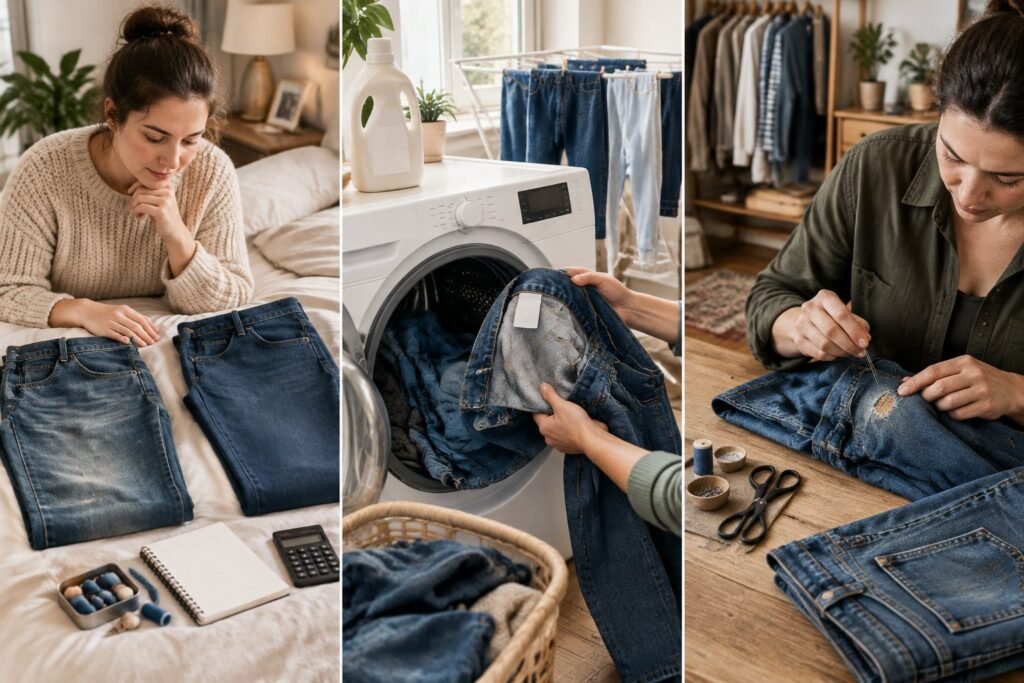
There is no universal washing schedule.
Wash jeans when they are dirty, smell, or need cleaning because of your activities. A lightly worn pair may be suitable for another wear, while heavy sweat, spills, or substantial dirt can require earlier washing.
A small informal experiment involving one wearer found bacteria but none that posed a health hazard.
That single-person example does not establish a general hygiene rule or mean jeans never need washing.
Follow the care label for your specific garment. The US Federal Trade Commission’s guidance explains requirements concerning care instructions attached to clothing.
Where permitted, turn jeans inside out, wash with similar colors, use appropriate detergent, and choose suitable cooler settings.
Air-dry when practical. Spot-cleaning can help with small marks, but airing or freezing does not replace washing away accumulated dirt.
Repair Before Replacing
Check frequently worn areas for thinning fabric, loose stitching, and damaged fastenings.
Small repairs may be easier to address before they become larger problems.
A tailor can sometimes replace a zipper, reinforce an area, or adjust a hem. Ask for an estimate and consider whether you would enjoy wearing the jeans afterward.
For wider ideas about maintaining a smaller clothing collection, see our guide to sustainable capsule wardrobes.
Common Mistakes to Avoid
Buying for an imagined lifestyle. Prioritize the activities that actually fill your week.
Keeping uncomfortable jeans because they were expensive. Their original price cannot make an unsuitable fit useful.
Following every trend. A new cut should work with your preferences and existing clothes.
Decluttering too quickly. Test a smaller rotation before releasing useful pairs.
Ignoring climate and dress codes. Denim cannot meet every clothing need.
Treating three pairs as compulsory. Your ideal count may be smaller or larger.
Review your collection when the season, your routine, or your fit needs change.
Frequently Asked Questions
Is one pair of jeans enough?
Yes, if you wear denim occasionally and have other bottoms available while it is being washed or repaired. Frequent denim wearers may prefer a spare.
Should I own black jeans?
Only if you would wear them regularly. Another blue wash or a different neutral may suit your clothes and preferences better.
Should I keep jeans that might fit again?
A limited stored selection can be practical. Set a review date and keep comfortable current clothes accessible rather than letting stored sizes dominate your closet.
Do seasonal jeans count?
Yes, when assessing everything you own. You can also track your active seasonal rotation separately to understand what you need available now.
Do jeans count toward my total bottoms?
Yes. Consider them alongside trousers, skirts, and shorts so your wardrobe remains balanced and covers different occasions.
Can trendy jeans belong in a capsule closet?
Yes. A fashionable cut can earn its place when you enjoy wearing it regularly and can combine it with clothing you already own.
Find Your Practical Number
For many women, two to four pairs of jeans create a workable capsule rotation. Three is a helpful starting point.
Keep pairs that fit comfortably, coordinate with your clothes, and suit your routine. Allow for laundry, weather, and changes in your needs.
Start by trying on what you own and tracking what you wear. The pairs you repeatedly choose—and the situations your wardrobe struggles to cover—will help you find your number.